Ferdinand Marcos Biography
Born: September 11, 1917
Sarrat, Philippines
Died: September 28, 1989
Honolulu, Hawaii
Filipino president and politician
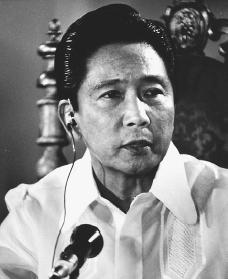
Philippine president Ferdinand Marcos began his career in politics with the murder of Julio Nalundasan in 1935, and ended it after the murder of Benigno Aquino Jr. in 1983. Some believe his entire life was based on fraud, deceit, and theft, and his time as president has come to represent one of the prime examples of a corrupt government.
Youth and family
Ferdinand Edralin Marcos was born on September 11, 1917, in Sarrat, a village in the Ilocos North region of the island of Luzon in the Philippines. His parents, Josefa Edralin and Mariano Marcos, were both teachers from important families. In 1925 Mariano Marcos became a congressman, surrounding the young Ferdinand in a political atmosphere at an early age. Mariano also had a strong influence on what was to become Ferdinand's competitive, win-at-all-costs nature. Mariano and Josefa pushed Ferdinand to excel at everything, not only his studies at school, but also at activities such as wrestling, boxing, hunting, survival skills, and marks-manship (skill with a gun or rifle). In college, Marcos's main interest was the .22-caliber college pistol team.
Marcos's real father was not Mariano but a wealthy Chinese man named Ferdinand Chua. (Marcos would claim that Chua was his "godfather.") Chua was a well-connected judge who was responsible for much of Marcos's unusual good luck as a young man. Among other things, Chua paid for young Marcos's schooling and later managed to influence the Philippine Supreme Court to overturn the young Marcos's conviction for murder.
On September 20, 1935, Julio Nalundasan was at home celebrating his congressional election victory over Mariano Marcos when he was shot and killed with a .22-caliber bullet fired by the eighteen-year-old Ferdinand Marcos. Three years later, Ferdinand was arrested for Nalundasan's murder. A year later, after having graduated from law school, he was found guilty of the crime. While in jail Marcos spent six months writing his own appeal for a new trial. When the Supreme Court finally took up Marcos's appeal in 1940, the judge in charge (apparently influenced by Judge Chua) threw out the case. Marcos was a free man. The next day, he returned to the Supreme Court and took the oath to become a lawyer.
Wartime activities
Throughout Marcos's childhood, the Philippines had been a colony (a foreign region under the control of another country) of the United States. However, the Philippines had been largely self-governing and gained independence in 1946. This occurred only after fierce fighting in the country during World War II (1939–45), the international conflict for control of large areas of the world between the Axis (Germany, Japan, and Italy) and the Allies (United States, Great Britain, France, the Soviet Union, and others). During
Reproduced by permission of
Marcos emerged from World War II with a reputation as the greatest Filipino resistance leader of the war and the most decorated soldier in the U.S. armed forces. However, he appeared to have spent the war on both sides, lending support to both the Japanese and the United States. In early 1943 in Manila (the capital of the Philippines), Marcos created a "secret" resistance organization called Ang Mga Maharlika that he claimed consisted of agents working against the Japanese. In fact, the group consisted of many criminals—forgers, pickpockets, gunmen, and gangsters—hoping to make money in the wartime climate.
At the war's end, Marcos took up the practice of law again. He often filed false claims in Washington, D.C., on behalf of Filipino veterans seeking back pay (wages owed) and benefits. Encouraged by his success with these claims, he filed a $595 thousand claim on his own behalf, stating that the U.S. Army had taken over two thousand head of cattle from Mariano Marcos's ranch. In fact, this ranch never existed, which made Washington conclude that the cattle never existed.
Political career
In December 1948 a magazine editor published four articles on Marcos's war experiences, causing Marcos's reputation to grow. In 1949, campaigning on promises to get veterans' benefits for two million Filipinos, Marcos ran as a Liberal Party candidate for a seat in the Philippine House of Representatives. He won with 70 percent of the vote. In less than a year he was worth a million dollars, mostly because of his American tobacco subsidies (financial assistance to grow tobacco), a huge cigarette smuggling operation, and his practice of pressuring Chinese businesses to cooperate with him. In 1954 he formally met Imelda Romualdez (1929–) and married her.
Marcos was reelected twice, and in 1959 he was elected to the Philippine Senate. He was also the Liberal Party's vice-president from 1954 to 1961, when he successfully managed Diosdado Macapagal's (1911–1997) run for the Philippine presidency. As part of his arrangement with Marcos, Macapagal was supposed to step aside after one term to allow Marcos to run for the presidency. When Macapagal did not do this, Marcos joined the opposition Nationalist Party and became their candidate in the 1965 election against Macapagal and easily won. Marcos was now president of the Philippines.
In 1969 Marcos became the first Philippine president to win a second term. However, not all Filipinos were happy with his presidency, and the month following his reelection included the most violent public demonstrations in the history of the country. Three years later, facing growing student protest and a crumbling economy, Marcos declared martial law, a state of emergency in which military authorities are given extraordinary powers to maintain order. Marcos's excuse for declaring martial law was the growing revolutionary movement of the Communist New People's Army, which opposed his government.
During the next nine years of martial law, Marcos tripled the armed forces to some two hundred thousand troops, guaranteeing his grip on government. When martial law was lifted in 1981, he kept all the power he had been granted under martial law to himself. Meanwhile the economy continued to crumble while Ferdinand and Imelda Marcos became one of the richest couples in the world. As Marcos's health began to fail and U.S. support for him lessened, opposition to Marcos grew in the Philippine middle class.
Final years
The Marcos regime began to collapse after the August 1983 assassination (political killing) of Benigno S. Aquino Jr. (1933–1983), who had been Marcos's main political rival. Aquino was shot and killed when he arrived at the Manila airport after three years in the United States. The killing enraged Filipinos, as did authorities' claim that the murder was the work of a single gunman. A year later, a civilian investigation brought charges against a number of soldiers and government officials, but in 1985 none of them were found guilty. Nevertheless, most Filipinos believe that Marcos was involved in Aquino's killing.
Marcos next called for a "snap [sudden] election" to be held early in 1986. In that election, which was marked by violence and charges of fraud, Marcos's opponent was Aquino's widow, Corazon Aquino. When the Philippine National Assembly announced that Marcos was the winner, a rebellion in the Philippine military, supported by hundreds of thousands of Filipinos marching in the streets, forced Ferdinand and Imelda Marcos to flee the country.
Marcos asked for U.S. aid but was given nothing more than an air force jet, which flew him and Imelda to Hawaii. He remained there until his death on September 28, 1989. The Marcoses had taken with them more than twenty-eight million cash in Philippine currency. President Aquino's administration said this was only a small part of the Marcoses' illegally gained wealth.
For More Information
Bonner, Raymond. Waltzing with a Dictator: The Marcoses and the Making of American Policy. New York: Vintage Books, 1988.
Celoza, Albert F. Ferdinand Marcos and the Philippines: The Political Economy of Authoritarianism. Westport, CT: Praeger, 1997.
Romulo, Beth Day. Inside the Palace: The Rise and Fall of Ferdinand & Imelda Marcos. New York: Putnam, 1987.
Seagrave, Sterling. The Marcos Dynasty. New York: Harper & Row, 1988.
Spence, Hartzell. For Every Tear a Victory: The Story of Ferdinand E. Marcos New York: McGraw-Hill, 1964.
That's why the Philippines is getting worst everytime there is a change of administration it is because we always think of Revenge. We haven't moved on to the brighter side because everyone wants to get back at each other...
Be fair when writing your article about Marcoses.
You people always taking, writing, accusing the dead man..and so the issues are useless..
Why we never write all his accomplishment..and accepting all this accomplishment that he does.
Going to the Marcos administration, you make it sound like the man did not accomplish anything at all. Many Filipinos are enjoying the benefits of the Philippine Heart Center, the Light Rail Transit, Kidney Center, Philippine General Hospital, North and South Expressways, Coastal Road, and so many other infrastructures that even the latter day politicians are trying to get credit for the things Marcos started.
With regard to the Bataan nuclear power plant, do you think we would have the power crisis of the 1990s if its operation was not stopped by the Aquino administration?
And, look. Corazon Aquino had six years to look into the killing of her husband Benigno. She had all the legal and political backing, or so she said. She could have brought all the facts into the open, once and for all. Why didnt she?
So please look deeper and closer into the events and personalities before you disparage everything about Marcos.Its not as simple as writing critical statements without looking into the background.
Im sure he was a better man than many of those in government now are, nor can they expect to approximate his achievements.
We known marcos for fraud, corruption, but the philippines during his time was the tiger of asia.# 1 in Asia and I guess #7 in continental. Lots of infrastructure, the ccp complex, ICCP, lung center, heart center, mrt, lrt, NLEX, SLEX, Bataan nuclear plant, gethermal plant, san juanico bridge, a lot..he's te only president who can do this. No one can beat marcos..
Marcos parin,.. VICTORY...
The oligarchs since the before the arrival of the European colonists have always influenced the culture in the islands wherein their control was dependent on dividing those 'under' them who were forced to choose sides as is evident in feudal societies!!
So chaos and divisive tendencies were the norm because just as you divide then conquer after the conquest the fragmentation must continue to prevent any form of unified rebellion!!!
Grand visions like '... a new society or bagong lipunan' fall prey to the allure that joining the ranks of the oligarchy and so attaining a higher status hence corrupting the visionary!
And the failed policies continued to this day that further enslave & burden the great Filipino people. The Philippines should have long defaulted on this odious Marcos debt like what Brazil, Mexico, Argentina ( paid 30 cents to the dollar with the bond holders), etc., did to their debts by renegotiating the loans. The country continue to be burdened by the ever-growing debt that the succeeding presidents followed through. A vicious cycle indeed that is breaking the current & coming Filipino generations. This is the fact supported by data.